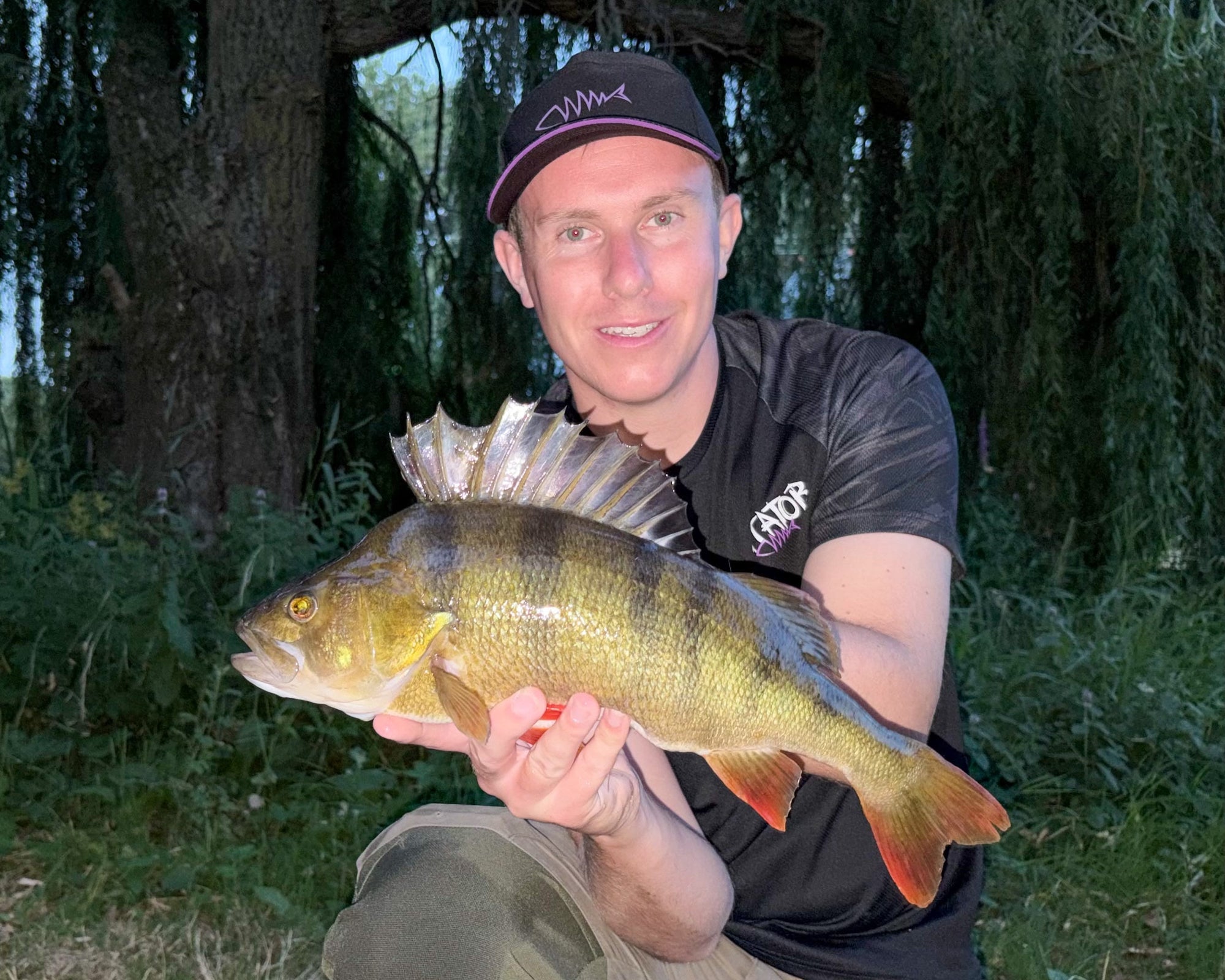
Chasing wild brown trout on one of England's most unforgiving rivers, Geoff Hadley proves once again why watercraft, the ability to endure and just being in the right place at the right time can lead to something special...
It just might be that, here in my little part of England's Midlands, I'm rather spoilt for fishing.
With two rivers and half a dozen pools just a short walk from my front door, plus several more within half an hour's drive, the angling possibilities are almost limitless. Being self-employed - I'm a landscape gardner, gotta love working outdoors - helps too, so if the work is up to date and the bank account is looking healthy, I'm in a pretty fortunate position to take advantage whenever the opportunity arises.
Most of my fishing over the last couple of years has been in the company of our youngest son, Will. We've recently kicked off our coarse fly-fishing campaign with a netful of perch, Will's first carp on fly and, more recently, his first River Dove brown trout.
It wasn't a big fish, but after missing or losing three or four trout during previous sessions on our club stretch, getting one into the net was a brilliant result.
This afternoon, though, I was fishing alone.
A grass and hedge-cutting job had finished earlier than expected, so rather than heading straight home I decided to take the scenic route and drop in on a stretch of the River Trent. I knew it held some seriously good wild brown trout and chub.
I pulled into a layby, pulled on my Gorge waders and fly vest, and started thinking about what to fish.
I'd originally planned to fish The Duo with my 10ft #4 Drift, pairing a big bushy dry fly with a chunky nymph. But one look at the bankside trees being rattled around by the wind changed my mind. Instead, I reached for my 9ft #5 Drift, paired it with an SLA Mk2 reel and Feather Floater line, finished with a simple eight-foot leader of 8lb Ghost Mode Fluorocarbon with a favourite weighted minnow streamer tied on with a Rapala loop knot.
It's my go-to setup when I fancy throwing a streamer on a river, and the Trent is certainly a river where you need to be prepared.
A river with attitude
Fly fishing the Trent is not for the faint-hearted; the banks can be high and frighteningly steep, overgrown and often undercut. There are few paths beyond the odd animal trail, and getting through the nettles, thistles, brambles and grasses — not to mention the Himalayan balsam — can be an adventure in itself.
Getting to the river is often a challenge. Getting into it can be harder still.
Then there are the fish.
These are 100% wild trout with an equally impressive head of wiley chub that love a fly. Both species are incredibly shy and tuned into their surroundings, so any careless movement, an errant footstep or a splash in the wrong place can be enough to ruin your chances before you've even made a cast.
Traditional fly-fishing etiquette says you should start at the downstream end of a beat and work upstream - the Trent doesn't really care about tradition. I slid down the first reasonably accessible section of bank and started working my way downstream, carefully covering the water ahead of me.
The river was at a lovely height and the flow was comfortable enough to wade up to my middle. I took things slowly, doing my best not to disturb the bottom or send waves ahead of me.
"Don't wade where you haven't put your fly" is the old adage that was firmly in my mind.
Three or four casts in a pool. Move carefully. Three or four casts in the next run. Move again. Sometimes that meant pulling myself out of the river and climbing the bank, occasionally backtracking upstream to find a safer way through.
A streamer is a great way of covering water quickly, but, as a good friend once said to me: you really need to find some fish that are on it. After several hundred yards of prime-looking river without seeing so much as a glimpse of a chub or trout, I was beginning to wonder whether I'd misjudged things completely, but at least I had some company - a kingfisher flashed past, undoubtedly the better angler I may add. Grey wagtails worked the margins, a couple of small groups of mandarin ducks moved along the river and, high above, both a common buzzard and a red kite circled overhead.
Beautiful, certainly, but I wanted a fish.
The sign I'd been waiting for
Eventually I pulled myself out of the river once again and decided to cut across the bankside meadow, skirting a long section of shallows before dropping back in upstream of a particularly interesting piece of water.
An old fallen oak had scoured out a deep hole below a shelf of exposed Trent bedrock. The rest of the swim was shallow, running beneath a canopy of far-bank sycamores. It was a horribly awkward place to cast.
I'd also spooked fish there on previous visits, so I approached with extreme caution. Parting the bankside foliage, I scanned the clear water through my Madison Signal polarised sunnies. Nothing showed in the shallows. Satisfied, I slid down the bank and carefully lowered myself onto the broad shelf of bedrock.
Then I saw them. A shimmer just off the riverbed.
Minnows.
Hundreds of them — perhaps two hundred — darting upstream as though something was chasing them. I followed their movement downstream with my eyes. The water in the deep hole was too dark to see into, but there was a simple piece of logic at work;
If the minnows were coming from there, that's where my streamer needed to go.
I took a couple of careful steps from the bank and knelt in the river, hoping to create just enough room for a cast. With the streamer in my left hand, I peeled a couple of rod lengths of line from the reel, flicked the rod tip upstream into the back cast and punched the line downstream before the overhanging willow could grab the fly.
The streamer landed with a satisfying plop beside the exposed roots of the old oak. I let the 4mm tungsten bead sink for a couple of seconds. Then I started the retrieve.
One strip.
Two.
Bang.
There was a sudden, savage jag at the end of the leader. Instinctively I struck, and a golden-yellow flash erupted from the darkness as the #5 Drift folded over - Fish on!
or to be precise, Trout on.
And a bloody big trout too.
The trout shook its head, writhed and then kicked its shovel-like tail. It shot straight for the near bank and the dark tangle of submerged oak roots. The rod hooped over.
I've caught some big fish on that 9ft #5 — carp, pike and stillwater trout into double figures — so I know just how much punishment it can take. But the sheer power of this wild brown trout had me worried for a moment that I'd finally found the rod's limit. Somewhere down the line I felt something grind. I lowered the rod and leaned it out towards the main flow.
The change of angle freed something and the trout changed direction, shooting towards midstream before crashing across the surface and launching itself into the air. I laid the rod over in the opposite direction, desperately trying to prevent any slack.
The fish turned again, straight back towards the snags.
This time I was ready and managed to pull it up short. The trout thrashed and flashed at the end of the line, seemingly lighting up the water around it.
Then it charged towards me.
It passed within a metre of my legs — I don't even remember standing up — and headed for yet another sanctuary beneath the upstream willow.
I held hard. The fish stopped. Its head thrashed. The rod unbent fractionally.
And suddenly the trout was on the surface, gliding towards me on its side. I yanked the net from the magnetic clip on the back of my fly vest and scooped it up in one movement. Then I bellowed a cheer into the sky.
A Trent treasure
54cm long. Solidly muscular. Around 4lb.
Almost certainly the biggest wild brown trout I've ever caught. I rested it in the net before carefully removing the streamer from the back of its mouth. Carefully for two reasons: the exertions of the previous few minutes had clearly taken their toll, and this trout had teeth that would have done a pike proud.

Image caption placeholder
It had absolutely nailed the streamer. The fact that the Ghost Mode Fluorocarbon had held against both those teeth and the submerged oak roots was testament to its strength.
With the hook removed, I let the trout rest again before taking a few photographs. The blue on its gill plates. The red spots along its flanks. The buttercup-yellow belly - a genuinely beautiful wild fish.
After another short rest, I released it back into the Trent and watched it disappear into the dark water. It's a fish that will take an awful lot of beating. A genuine privilege to see, let alone catch — and probably the highlight of both my coarse and trout seasons rolled into one.
The River Trent might be a very, very tough taskmaster, but the rewards are there, you just have to be brave enough — or daft enough — to go looking for them.

Image caption placeholder