Wychwood’s Matt Poulton heads back to an old haunt, The Folly, a venue that he score to settle with and one that presents a challenge that many carp anglers fear – weed!
With carp fishing evolving faster than ever, it’s easy to lose sight of what the sport truly represents. For me, that means going back to where it all began — wild margins, clear water, and the unmistakable allure of genuine old English carp. So when the chance came to film a session at the legendary Cambridgeshire “Folly”, I knew it was time to revisit unfinished business.
When Rob, our cameraman, rang about doing a short filming session at the Folly, I could barely contain my excitement. It’s a venue that holds a deep connection for me; positioned just outside Peterborough yet somehow managing to feel miles from anywhere, and despite the hum of nearby roads, once you’re on the banks and surrounded by old trees and the stunning scenery, you feel completely immersed.

For me The Folly represents a throwback to what I imagine it was like in the halcyon days of carp fishing before the explosion; there’s an intimacy about the venue that gives a sense of isolation and you also feel like you’re stepping into an arena where this is not just angler against fish, you’re on the carp’s terms now and you’re going to have to prove yourself to get one over on them.
That’s exactly how I like it and I love the idea that alongside big fish, there are equally amazing smaller residents who’ll give as good as they get and won’t come in without a fight. It’s a venue that demands tactical precision and the ability to adapt, rewarding observation and effort, with deep gullies, dense weed and shallow margins to perplex and amaze in equal measure. After a brief lull in popularity, new management has restored the lake’s potential, and it’s shaping up to be one of the most exciting waters around.

As always on any water whether it’s somewhere familiar or unknown, location comes first. Polarised sunnies on, I’m usually straight up the trees when allowed, scanning every margin for signs of life. On this water especially, staying one step ahead is vital — the fish are wily, pressured, and often tucked into hard-to-reach places. Using amber lenses to cut through the surface glare, I spotted a small group of carp patrolling a consistent margin line. From experience, I knew that if they were comfortable there, they’d run that bank day and night – so I chose to set up on the end of that margin in a swim known as “Lower”, fishing into a secluded corner. This area offers both cover and depth variation — the perfect blend for a tactical session.
I don’t know the full history of the venue and how it came to being, but the lake has all the hallmarks of what we imagine a gravel pit to be like; the lakebed changes constantly, with contours aplenty that present numerous opportunities – and obstacles - so even with prior knowledge, my first task is always to re-map a swim. In a digital age of bait boats and fish finders, casting out a 3oz flat pear under a marker float over and over seems a little like hard work, but I would prefer to actually ‘feel’ the bottom and then work out depths, rather than be told just how deep somewhere is on a screen. I think that’s a hugely important factor in having a confident approach on waters where heaving all your ducks in a row is essential; fishing throws you curve balls but if you can minimise any potential upsets, then you’re better placed to getting a fish to the bank.
As an aside, for marker work and leading around, opt for a lead with a flat side, as it’ll pull across any gravel with better feel down the line than a round lead. Also, use a good quality braid; I’m using AX8, which is from Wychwood’s predator fishing arm, Agitator. It’s designed for lure fishing where you can’t have any degree of stretch so is perfect for this application.

After casting progressively across the swim, on this occasions I built up a mental map of the contours, locating a clean gravel margin near the island, and to the right, a soft silty gully bordered by weed beds, which is classic autumn feeding territory. The third rod would go on a hard spot in the deep margin, identifiable by its pea-gravel texture and clean presentation zone.
Weedy waters are my thing, they just seem to have a real allure to them. Not only does it offer protection for fish, it’s also a place where there’s food in abundance, so you can see why fish like carp love it.
On waters where angling pressure is high, you can see why it’s where fish retreat to hide, or at the least, they stay close to it for cover - It’s like an all-inclusive hotel where carp can just relax! There’s a lot of info out there about fishing into weed, but are there any rules of thumb that I adhere to? The most obvious one for me is just to do my due diligence and find a spot in weed that I can present a bait cleanly over. Some anglers like the challenge of fishing deep into weed, regardless of whether there’s a clean area or not, and in some case, the density of the weed just doesn’t allow you to find clear spots. But in my mind, as the fish spend a lot of time in the dense weed, then it’s more often than not the clearer areas that are closest to them that become their feeding spots - when you combine a nice polished area surrounded by dense weed it can often be a gold mine for bites.

One thing that is massively overlooked when fishing heavily weedy waters is line lay; after all line is one of the single biggest reasons carp spook from areas. There’s usually so much prep gone into the rigs, the bait and actually finding spots, but it can be all too easy to just underestimate the angle of attack and how that will interfere with a fish that’s looking for a safe feeding spot. Fishing bow-string tight is a total no-no for two reasons; the first is it’s easier to spook a fish because they’ll have more chance if swimming into the line, that’s pretty standard thinking for any weed situation. The other is down to debris collection; bite detection can be severely compromised by anything that gets attached to the line and if you’re fishing tight, there is more possibility of anything floating around to cling onto the line, either giving false readings or acting against of the mechanics of the rig. It can also be a massive pain when it comes to landing fish, as the weed becomes a serious hazard that could see a hook thrown or line snapped.
The rule of thumb should be that you have the cleanest, most direct line between your fishing position and the clear spot, even if that means where you’re fishing from doesn’t look the most appealing. Unless you’re out for a comfortable day in a nice open swim, then you sometimes have to sacrifice that for a better way of presenting both bait and the mainline.
But what if none of that applies? Well, you have to try to imagine the contours off the weed and how your line can lie on the top to follow those contours. Slack line fishing or fishing semi-slack is the order of the day, of which I prefer the latter because there is tension in the line but it’s no super-tight, it cuts off the weed in places and in it in others. Traditional bite detection does becomes compromised in a sense; If you’re relying on the normal back and forth movement of line that translates to the bobbin going up and down, if weed fishing is new to you then you may have to get used to less of that and more being like a coiled spring to hit bits before they go ballistic. A taking fish won’t necessarily go away from you when it’s hooked but what will happen is, due to the slackish nature of the line, it’ll build up a bit of momentum before the line goes taught and the buzzer screams. That’s when you need to be on your toes to get onto the rod and really lean into a fish that’s now gathering a bit of speed and also heading to the safety of dense weed. It’s not as extreme as snag fishing to tree stumps, but it still demands a high degree of alertness to ensure you’re minimising the amount of weed that’s picked up, and that you’re in control.
Confidence in your rigs is everything. For this session, I stuck with a proven favourite — the Slip-D rig, or what some know as my “Gamwamwig rig.” Constructed using my trusted Thinking Anglers components, each hook is meticulously sharpened, with a small section of silicone tubing acting as a kicker for easy hook changes mid-session. This is very much my go-to rig for clean gravel or fishing over thin layers of silt. When it comes to rig mechanics in weedy conditions my rigs don’t tent to change too much, as predominately I’m still looking for the clearer areas around the weed to present a hook bait. The main thing is you need a setup that will engage quickly and set the hook before the line has even had a chance to register on the alarms, due to the nature of fishing semi-slack lines.

Since we’re talking about weed, on those occasions when there is no option but to fish into the dense weed (and not onto a spot) then I look no further than a long, running chod, which from my own experiences is the only rig that will present over weed without the worry that you’re not fishing effectively.
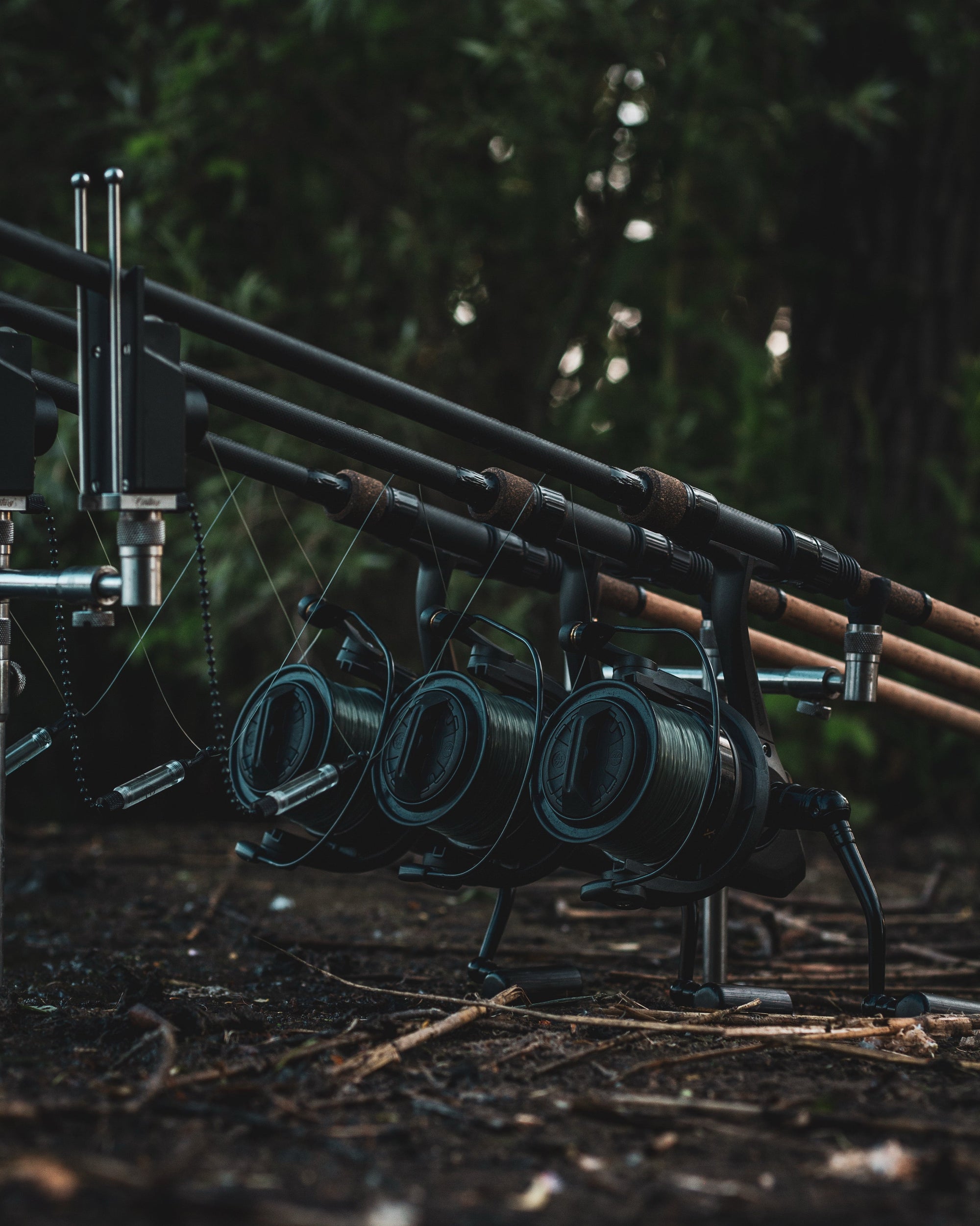
Tackle-wise my rods of choice are the Wychwood Epic 12ft ARs — the AllRound designation is well-earned, providing the perfect combination of casting distance, sensitivity, and control up to 120 yards. The feedback through the blank allows you to feel exactly how your rig settles on the lakebed — a huge confidence booster when fishing over varied ground. I will state that you need to be safe and I’d never attempt fishing near or in weed without a minimum of 0.40mm mainline, or where rules allow, a braided mainline. It’s also thinking about if you need to revise hook gauge to match; if you predominately fish clear, open water it could be that the hook you feel is super-strong and super-reliable might not quite be up to the rigours of fishing into weed where you have to apply more pressure and more force. If there is an option within the range of hook you use to move up a gauge then do so, as the effects on rig mechanics will be negligible and you’ll be safer in the long run.

The Baiting Strategy
Baiting strategy really is venue dependent, as per the fishery rules, but thankfully The Folly allows a variety of baits to be introduced. This session I’ve used RG Crab boilies, hot shrimp pellets, and a measured helping of freshly chopped worm. The latter is particularly effective in cooler months, releasing natural amino triggers that carp instinctively home in on.
Obviously, the dominant bait varies from venue-to-venue but where boilies are the primary food source from anglers – let’s face it, where isn’t dominated by boilies these days? – and my starting point will always be an outright boilie approach, as I believe it makes everything much easier, both to introduce and to manage feed amounts. A spread of boiles with a throwing stick gets the fish moving between mouthfuls, and a moving carp is infinitely easier to hook than one that just sat on the bottom.
But as I’m writing this in early Autumn (and you’ll be reading this with one eye on Winter) then I’ll focus on the shift to colder temperatures where carp become less inclined to move too far and might not respond as well to a boilie-only approach. Autumn demands a slightly different approach to baiting than it does in Summer when fish are gorging themselves, and I start to look towards variety of feed. As the water cools, natural food sources decline and carp become increasingly opportunistic so I reign things in with less main food source – boilies – and more smaller, easier to digest feed and naturals.
In this instance, each baiting zone was treated differently; a few Spombs over the island gravel and the open-water gully, and just a light scattering by hand over the margin spot. At this time of year the goal isn’t to feed heavily but to create highly attractive micro zones that encourage the fish to have a look but not spook them.
In terms of delivering a mix of bait types, a Spomb does a great job. I just have wetted pellets in a bucket with the boiles and chopped worms. It’s a bit of a mush but gets through the water column well without drifting around much, and if anything, those jouces and particles create a bit of a signal at all depths that there’s food below. The other thing it does is creates interest for fish; any active fish can be kept in an area to sift through the bit of worm, boilies and pellets, which wouldn’t happen if it was just boilies being fed. These baits also have varying densities too, so they’ll act differently in the water as they get stirred up, and they’ll also settle differently on any weed that’s near and won’t get lost. If you’re fishing into dense weed then this is a consideration.
Hook bait choice again is all venue dependant but my general rule of thumb is brighter hook baits through the Winter and Spring when the water is clearer, and more ‘match the hatch’ in the Summer and Autumn when baits are being presented within larger groups of food.

The Session
After extensive feature-finding and getting swims prepped, by nightfall I was settled in and watching the sky fade over the Cambridgeshire countryside. At 5am, tranquillity was replaced by chaos as the gully rod tore off. The braid transmitted every surge, every vibration through the rod — it was pure adrenaline – and after an intense battle through several weedbeds, the fish was safely netted: a stunning, heavily plated mirror that just looked amazing in the morning light.
After securing it in the retainer, I quickly re-cast onto the clip-marked spot — consistency is everything, I think I’d be lost if line clips didn’t exist!— before brewing a morning coffee and waiting for the sun to fully rise. As dawn broke, the camera captured the perfect prize: an immaculate old Folly mirror, dark, broad, and full of character. It’s fish like this that set the fire in me about this venue, and fishing in general. No matter how big they are, when they look great it just totally validates the time and effort you put in.

The following day, I resumed observation, walking the banks and noting subtle surface disturbances and bubbling. I know a good number of anglers want to kick back and chill when they go fishing – that’s cool, whatever floats your boat – but for me, I’m always asking myself “Am I doing enough?Can I make something happen?” and that often means assessing whether things have changed and if my approach, my position on the lake is the right one.
Thankfully, after a full lap of the lake, the fish had remained on their patrol routes, confirming my initial assessment of the venue and that I was in the right spot. As afternoon drew in, I topped up the gully with a few pouchfuls of 12mm crab boilies to maintain interest. This was done via a throwing stick, as firing a Spomb over the top of them just didn’t feel right.
Not long after, while mid-conversation during filming, the right-hand rod screamed off, another brutal take. The direct feedback of braid can make your toes curl during these encounters! After a spirited fight and some intricate rod work to avoid tangles, another old character — Big Bad Barry — was resting safely in the net. A recapture for me, but no less satisfying and validation I’d got my tactics on the money.
I’m not sure I’d say scores were fully settled with the venue – I’m still yet to catch the biggest fish - but when fish fight this hard and look so gnarly and cool, it’s hard to leave a venue feeling anything but elation and that’s what carp fishing should be about…

Takeaways and Tactical Reflection
This session has reinforced a few key principles that can be applied generally across carp fishing, but also when it comes to fishing weedy venues:
• Location trumps all — even on familiar venues, never assume the carp are where they were last time.
• Precision and presentation — use your marker setup to ensure every cast lands true and in the feed zone.
• Confidence in your kit — rigs and bait you trust will always outperform experimental setups you second-guess.
• Weed is not the enemy — it’s the carp’s home so think logically about where fish will patrol and hide and from which angle you attack those clear spots.
Tight lines
Matt